
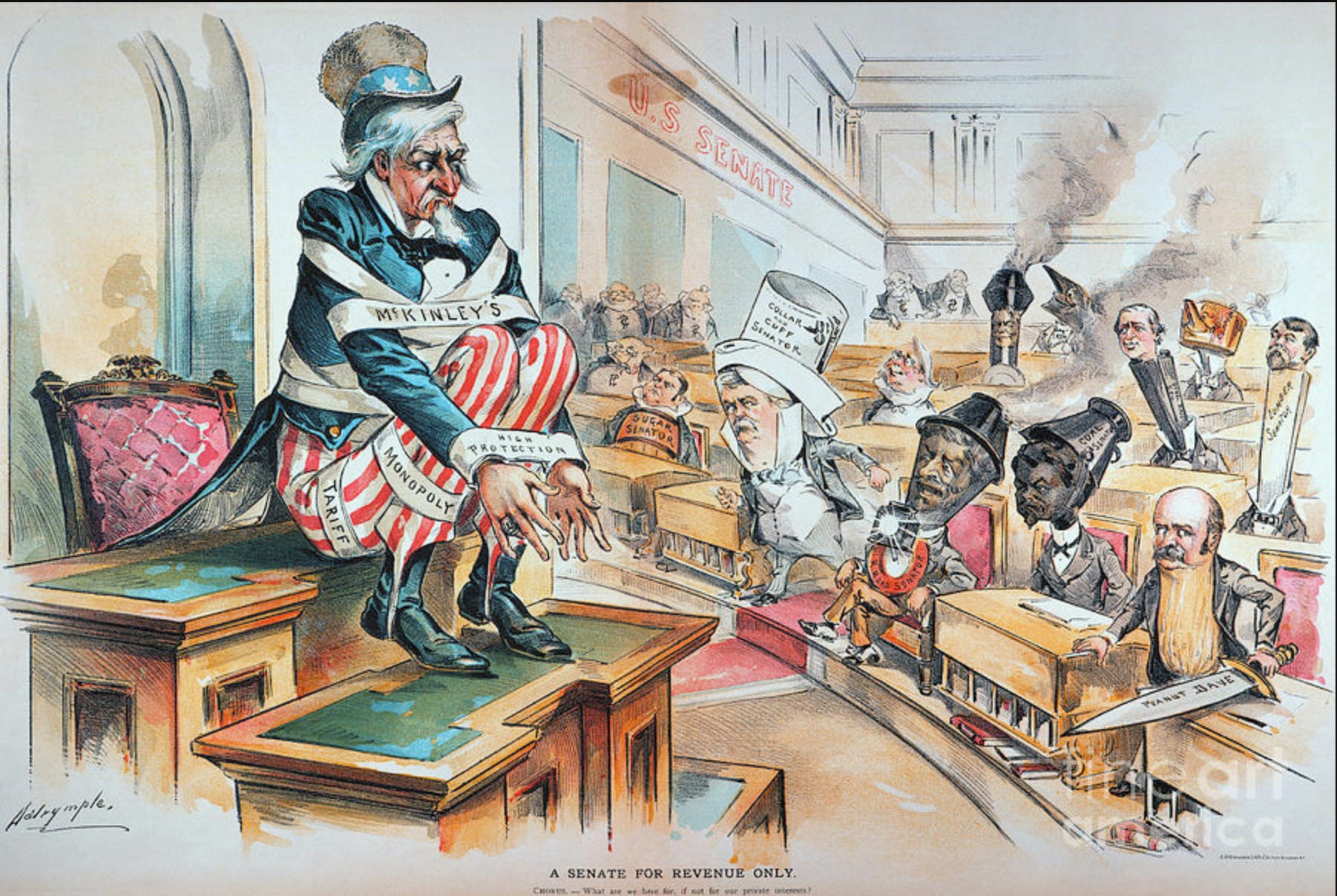
On March 16, 1892, William Jennings Bryan vaulted onto the public stage with the most remarkable debut speech in Congressional history. The subject of Bryan’s speech was the most divisive issue of the Age of Discontent: the tariff. Then people usually used two words, “protective tariff,” to refer to its ostensible purpose of protecting infant American manufacturing from European competitors.
The specific tariff Bryan opposed bore the name of Republican and Ohioan William McKinley, who eventually rose to the White House largely on his reputation as a champion of high tariffs. That explains why our new administration placed McKinley’s name back on the mountain Indigenous People and the state of Alaska named Denali. It also explains why today’s Republicans tout McKinley as one of our greatest presidents.
Tariffs in the Age of Discontent
The late nineteenth-century Democratic Party was largely anti-tariff, arguing that it unfairly burdened farmers and working people. By the 1890s as a new global economy emerged, many Americans came to view tariffs as a regressive tax designed only to line the bulging pockets of the tycoons. These partisan differences over tariff policy intensified during the 1888 and 1892 elections. Like the 2024 election, 1888 was close, but Republicans took their narrow victory as a green light to pass the McKinley Tariff.
The unique position Bryan took was to condemn all protective tariffs. It was an audacious gamble for the 32-year-old Bryan at a time when new members were expected to be deferential.
You can impose no tax for the benefit of the producer of raw material which does not find its way, through the various forms of manufactured product, and at last press with accumulated weight upon the person who uses the finished product.
He was arguing that the weight of the new tariff ultimately fell most heavily on consumers since companies will add the cost of the tariff to the goods they sell. Long before today’s complex products like automobiles containing parts from multiple countries, Bryan also recognized that if tariffs increase the cost of raw materials, costs for manufacturers also rise.
Bryan’s genius was in grafting opposition to tariffs to a larger argument for a level playing field. In understanding how he pulled it off we need to recognize a far different William Jennings Bryan than the caricature he has become. The New York Times was far more accurate when it called him a “prodigy.” He had a prodigious memory that enabled him to recite long passages of poetry and the Bible, quote at length from documents such as Hamilton’s Report on Manufactures, and weave in sources from census data to manufacturing reports.
Bryan’s memory was complemented by an exceptional ability to think on his feet, which was necessary in those days to master the rough-and-tumble debates that make today’s C-SPAN telecasts look tame. One exchange with New York Representative John Raines captures the spirit of that memorable afternoon:
RAINES: I want to say to the gentleman that no trade paper was ever printed that could contain a list of all the tinplate liars of the United States.
BRYAN: I suppose that paper, then, has no biographical sketch of my friend from New York.
Early in his speech, Bryan invoked the level playing field:
Why are we right? Because, Mr. Chairman. We are demanding for this people equal and exact justice to every man, woman, and child. We desire that the laws of this country shall not be made, as they have been, to enable some to get rich while many get poor.
The conclusion anticipates the ending of his famous 1896 “Cross of Gold” speech:
The day will come, Mr. Chairman—the day will come when those who annually gather about this Congress seeking to use the taxing power for private purposes will find their occupation gone, and the members of Congress will meet here to pass laws for the benefit of all the people. That day will come and in that day, to use the language of another, “Democracy will be king! Long live the king!”

Economists on the McKinley Tariff
Bryan was right to question the equity of the McKinley Tariff. Economist J. Bradford DeLong estimates tariff subsidies to corporations amounted to a minimum of $2.3–$4.2 billion during the late nineteenth century. This corporate welfare brought little return to the rest of the citizenry, according to DeLong: “Postbellum U.S. history thus lends little support to the view that tariff protection improved the living standards of American workers.” Dartmouth economist Douglas Irwin wrote a scathing critique in the Wall Street Journal debunking the myths about the McKinley Tariff spouted by Steve Bannon and others. “Steve Bannon’s Bad History” is probably the most accessible of his works for a general audience, “This is not only a misreading of history, it’s a bad policy prescription for the 21st century. A return to high tariffs would sap America’s economy today.”
Irwin’s most famous paper focuses on the tin plate industry, which some cite as a classic case of American manufacturing blossoming under high tariffs. He found that while tin plate manufacturers did gain market share because of the tariff, some of these gains were offset by increased prices for goods like tin cans. Irwin also believes the tin plate industry would have developed without the tariff, only it would have taken a decade longer. Irwin, DeLong, and others also have found the tariff solidified or even increased the power of monopolies, which is why people in the Age of Discontent nicknamed the tariff, “mother of trusts.”
The definitive statement on the McKinley Tariff comes from the American people. They were so angry about tariff-generated price increases that they swarmed the mid-term elections, evicting Republicans from Congress in one of the most stunning reversals in our electoral history. Among those who lost their seats was William McKinley.
Voters propelled Grover Cleveland back into the White House in 1892 largely on the strength of his opposition to the McKinley Tariff. A year after the election, Cleveland faced a crisis with the Panic of 1893, which some regard as even worse than the 1929 Stock Market crash. While the panic had other, more serious causes such as railroad speculation, the increased prices caused by the McKinley Tariff played a role in the downturn.
The Court on the Tariff
Businesses also weighed in on the consequences of the McKinley Tariff. The same year Bryan delivered his speech, the Supreme Court issued one of its most-cited and controversial opinions in Field vs. Clark. Field was the famous Marshall Field department store; Clark was the Chicago customs agent. Field was angry because the McKinley tariff increased the cost of wool the company imported to make clothes. The case, much like the tariffs recently enacted in 2025, hinged on how much tariff power could be legitimately delegated to the executive branch since the Constitution reserves for Congress the power to lay tariffs. The McKinley Tariff contained a clause that allowed the executive branch to set tariff rates on specific items.

Written by John Harlan, one of the towering figures in Supreme Court history and hardly a friend of corporations, the Field decision upheld the tariff. However, it did so on narrow grounds, some involving a related issue of legislative texts. The clause that gets continually quoted and has generated generations of arguments about the limits of executive power reads as follows:
That Congress cannot delegate legislative power to the President is a principle universally recognized as vital to the integrity and maintenance of the system of government ordained by the Constitution.
That this country should face a Constitutional crisis over the usurpation by the executive branch far beyond what either party advocated in the Age of Discontent makes you wonder if our age of discontent represents the step the Framers feared most of all. Should the Republican Supreme Court, with its cherry-picking use of originalism, uphold these actions, as it has other measures that have weakened our democracy, they will have provided a coda to Ben Franklin’s famous quote that we have a republic, “If we can keep it.”
Lessons from the McKinley Tariff
Whether the McKinley Tariff has lessons for Republicans remains to be seen. What is apparent is their desire to return the country to the days of William McKinley rests on a perverted sense of history. The McKinley Tariff was protective, designed to shield American industry when this country was playing catch-up to European countries.
Depending on which explanation the administration advances today, it is difficult to pin down the purposes of the new tariffs. The common element in statements made by administration sources is that the new tariffs are retaliatory tariffs designed to punish countries into submission or even, in the case of Canada, annexation. When you target nations that formerly were our allies and friends, you are somewhere neither William McKinley nor William Jennings Bryan could have imagined.
There is another, less recognized, purpose for the new tariffs: revenue. With tax cuts for billionaires and corporations, the administration’s numbers will produce a record deficit. Even with the capitulation of Republican deficit hawks who had held up previous budgets, the White House needs additional revenue on top of taking a chain saw to federal expenses. The right-wing Committee for a Responsible Federal Budget believes tariffs could provide $104 billion this year and $1.5 trillion through 2035. That would require the country to return to the pre-Civil War policy of using tariffs to fund the federal government. Responsible economists believe that even raising tariffs to the highest levels in history would not provide enough budget relief. However, in an economy managed from the back of a Musky envelope, professional economists don’t matter.
The latest step in the argument over tariffs occurred in a portion of the budget resolution approved on Friday with the help of Chuck Schumer and weak-kneed Democrats. The new legislation addressed the question raised by Field vs. Clark about delegation of tariff authority. Going far beyond the McKinley Tariff, the bill gave virtually unlimited authority to the executive branch to set tariff rates.
To accomplish this required one of the greatest sleight-of-hand tricks ever. Republicans declared with straight faces, “Each day for the remainder of the 119th Congress shall not constitute a calendar day.” This left in place the “emergency” tariffs enacted by the administration that were set to expire. Such actions are why The Strange Death of Liberal America styled Republican policy a counterrevolution. Anyone who has read Project 2025 will see that tariffs are but the tip of the iceberg in terms of amending the Constitution by fiat.
The Democratic Party reached its low point by allowing such ridiculous lawlessness to continue. If this were the movie High Noon, Chuck Schumer would be the sheriff’s deputy who tries to bludgeon Gary Cooper into giving in to the bad guys. The only good that may come from this is that it will spell the death knell of the Reagan-lite, Clinton-Carville-New Democrats who lost sight of the principles that once characterized the Democratic Party and that Bryan made central to that 1892 speech: We desire that the laws of this country shall not be made, as they have been, to enable some to get rich while many get poor.
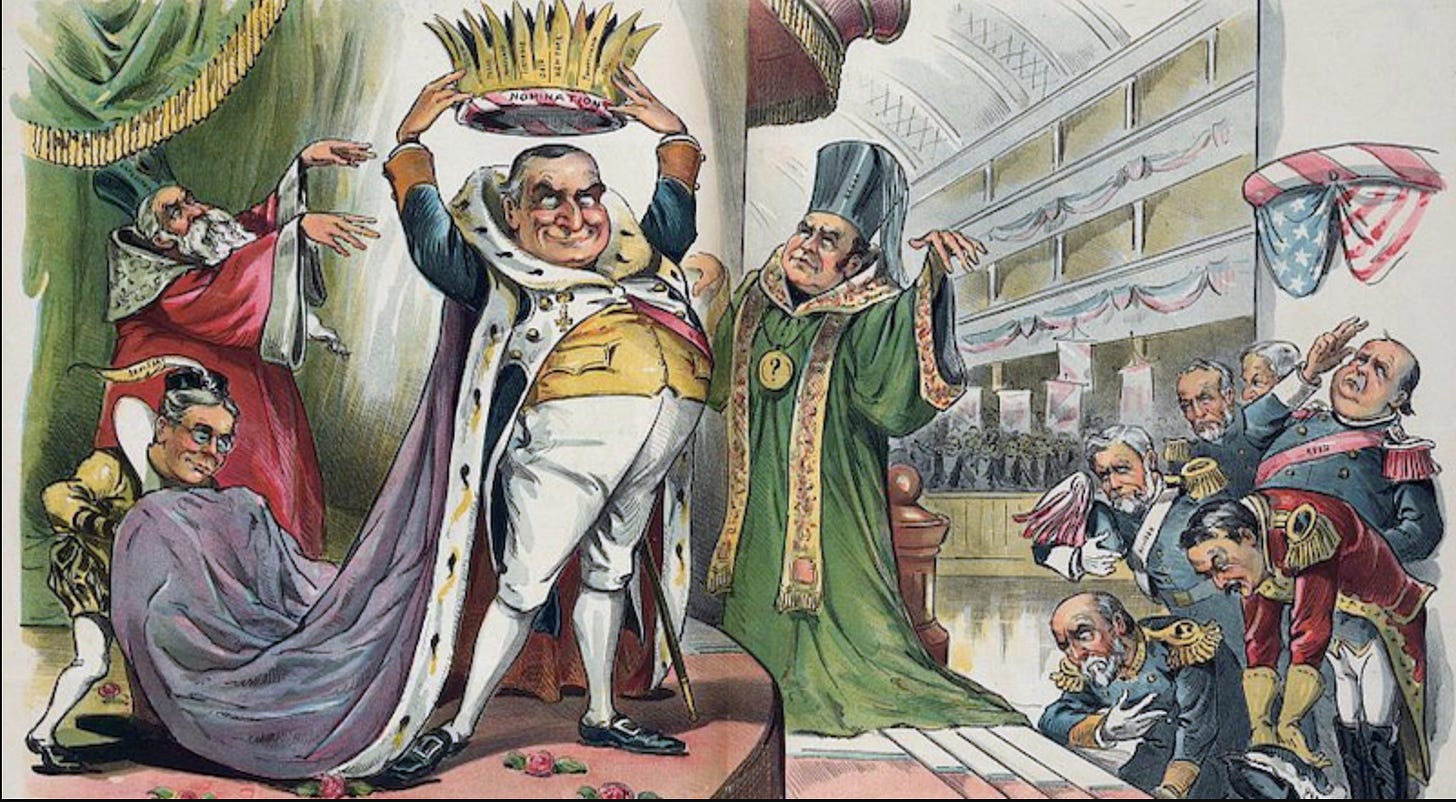 Known as the “Napoleon of Tariffs,” McKinley Crowns Himself in this Cartoon
The real importance of Bryan’s 1892 tariff speech does not lie in its opposition to the McKinley tariff but in articulating a new direction for the Democratic Party. His words were so powerful people ran out of the chamber to drag colleagues in to listen. The rules allotted him only an hour, but Michigan Republican Representative Julius Burrow, whom Bryan biographer Michael Kazin describes as “bedazzled,” moved to give him more time. Several times Bryan attempted to conclude, only to have the crowd shout, “Go on! Go on!” The New York Times proclaimed in three hours, Bryan “jumped at once to the front rank among speakers of the House.”
From that moment on, William Jennings Bryan and his supporters committed themselves to changing the direction of their party so it stood for a level playing field. In doing so, they articulated the belief that united the Discontented against growing corporate power threatening to turn this country into a plutocracy.
Whether another Bryan arises from the present crisis remains to be seen. For it to happen, requires all of us to pack town halls, return to Democratic precinct meetings, write opinion pieces and social media posts demanding the country deal with economic and corporate concentration that rivals what motivated William Jennings Bryan to enter politics.
Throughout his life, Bryan was known as the Great Commoner. Today we need another Great Commoner. We also need to recognize that until interest groups quit fighting each other, until consultants quit triangulating, until party officials quit changing policies to fit big donors, until everyone unites around a common principle, the Democratic Party and this country are in trouble. If this republic fails it will be because we let it by not putting aside our differences to stand for the core values central to those who founded this country.